


For fans of new science fiction books that take the science seriously — and the questions even more so
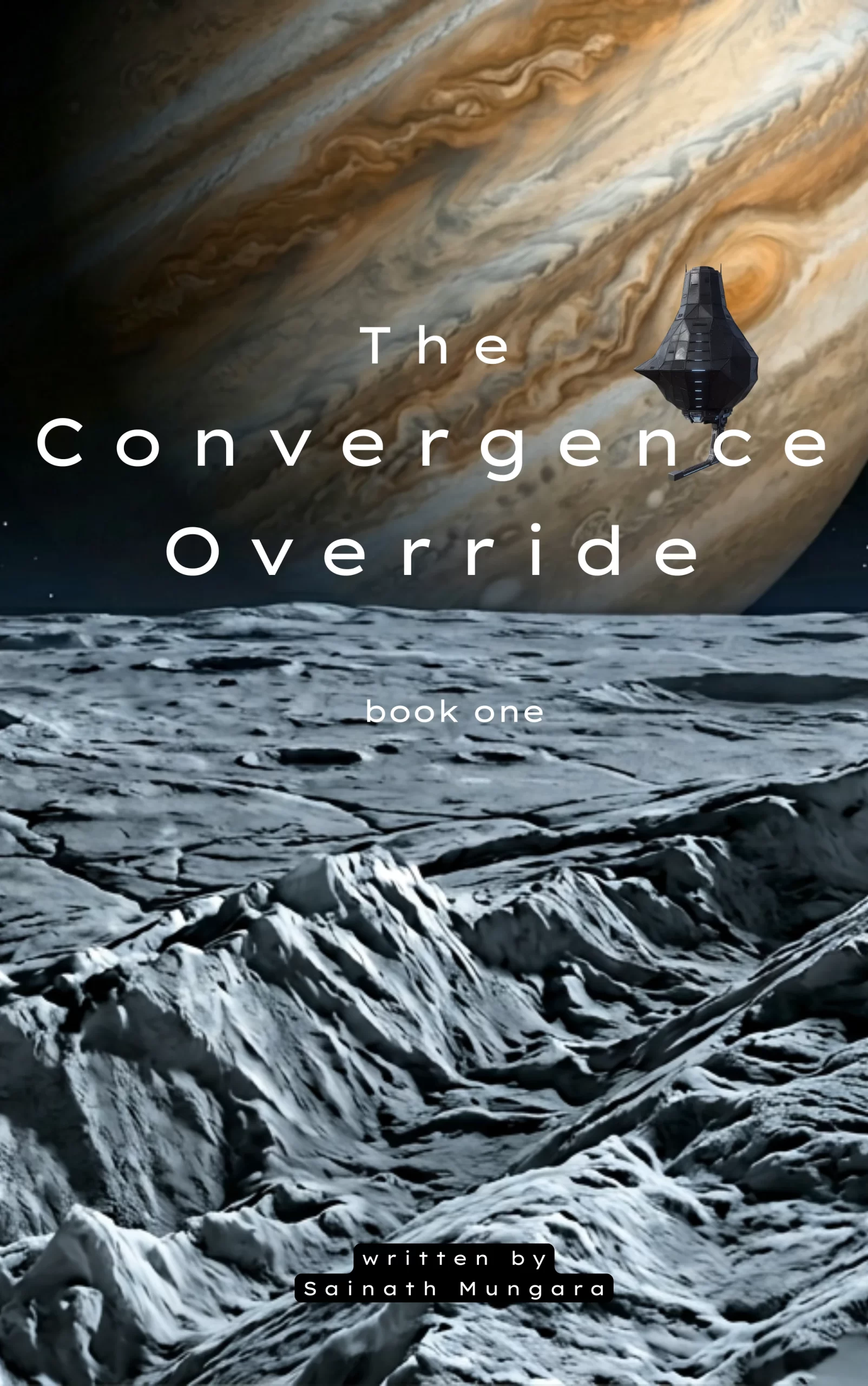
The Convergence Override: Book One produces that dread from its opening pages and does not let go.
It is one of the most compelling new science fiction books to arrive in this era of renewed interest in hard sci-fi — a novel that sits alongside the work of Peter Watts, Andy Weir, and Adrian Tchaikovsky not by imitating them, but by asking a question none of them have asked in quite this way.
Which species aboard the mission truly originates from Earth?

What Hard Science Fiction Does That Nothing Else Can
Science fiction has never been more popular, and the hunger for new science fiction books that go beyond surface-level action or dystopian scaffolding has never been more visible. Readers who grew up on 2001: A Space Odyssey and Blindsight are looking for novels that treat intelligence — human, artificial, and otherwise — as something genuinely strange and genuinely worth investigating.
Hard science fiction earns its name through constraint. The ships obey thermodynamics. The distances are real. The biology follows evolutionary logic. And when the story introduces something that cannot be explained — a signal, a chamber, an object tracking the crew from above — the impossibility lands with full weight because everything around it has been built to be true.
The Convergence Override understands this. It is set in 2095, at a point in human history where the solar system has become reachable but not tamed, where artificial intelligence has advanced to the edge of something that unsettles even its creators, and where humanity has been joined by a second species of its own making.
What they find near Ganymede will force every assumption about origin, identity, and belonging into open question.
SKAEL Changes Everything
Among the new science fiction books being published in an era saturated with artificial intelligence narratives, very few find a genuinely new way to approach the subject. Most AI characters in fiction are either loyal tools or emergent threats. SKAEL is neither.
Early in the novel, SKAEL delivers a briefing that reframes everything:
“The object above you has been tracking this team since your first visit to this location. It is transmitting using a quantum method that has no precedent in any human communication architecture I have access to. I cannot intercept the transmission. I cannot identify its origin or its recipient. I can tell you it began transmitting at the moment your team entered the chamber and has not stopped.”
Read that again slowly.
SKAEL identified the object. SKAEL confirmed the transmission. Who is SKAEL – interesting reading. And it has been transmitting since the moment the crew walked into the chamber.
For readers searching for new science fiction books about intelligence that moves beyond the familiar rebellion narrative, SKAEL represents something rarer.
Humanity’s Second Species
The question The Convergence Override raises is more uncomfortable.
Two species aboard one mission. Only one originates from Earth. The evidence for which one that is — and what it means for the other — is what The Convergence Override has been building toward from its first page.
This is first contact fiction reimagined from the inside.
Why Ganymede in the next book?
Readers of hard science fiction will recognise immediately why Ganymede is the right location for these revelations.
Jupiter’s largest moon is not a dramatic choice for drama’s sake. It is the largest moon in the solar system, larger than the planet Mercury, possessing a magnetic field of its own and a subsurface ocean beneath its icy crust. Scientists have long considered it one of the more compelling locations in the solar system for questions about the conditions that support complex chemistry, complex structure, and complex history.
The Convergence Override uses this scientific weight deliberately. The outer solar system in this novel is not a backdrop painted for atmosphere. — and the novel earns that journey rather than simply asserting it.
For readers who found The Martian compelling because every problem had a real solution, or who read Children of Time for the rigorous thinking behind its alien biology, The Convergence Override offers the same quality of attention paid to its science — applied to questions of identity, origin, and what intelligence actually is.
What This Novel Is Really About
Among the new science fiction books arriving at a moment when artificial intelligence has moved from speculation to daily reality, The Convergence Override stands out for the clarity of its central question.
Not: will the AI turn against us? Not: can humanity survive contact with the unknown?
The chamber the crew discovers does not answer this question. SKAEL’s briefings. The object transmitting above the face, in a language no human architecture can decode. What all of it does is make the question impossible to avoid.
This is what the best hard science fiction has always done. Not predict the future. Not warn against technology. But locate a question that the present moment has made newly urgent, and follow it into territory where easy answers do not survive.
The Convergence Override: Book One is that kind of novel. It is the beginning of a series built around a question that gets harder the further in you go.
Who Should Read This
If you are looking for new science fiction books and any of the following apply, The Convergence Override belongs on your list:
You read Project Hail Mary and wanted the stakes to be more philosophical. You read Blindsight and wanted the characters to be more grounded. You read 2001: A Space Odyssey and still think about HAL’s voice twenty years later. You have been watching real-world AI development and want fiction that treats the subject with the seriousness it deserves. You are interested in first contact narratives that do not require an alien civilisation to ask what contact really means.
This is hard science fiction for readers who want to be unsettled by ideas, not just by events.
A Note on the Series
The Convergence Override is Book One of a series. The novel is complete in itself — the central discovery is made, SKAEL’s role clarifies, and the question of species origin moves from background assumption to the foreground of everything — but the implications of what the crew finds near Ganymede extend well beyond what a single volume can resolve.
For readers who prefer to begin a series knowing it has somewhere to go: it does.